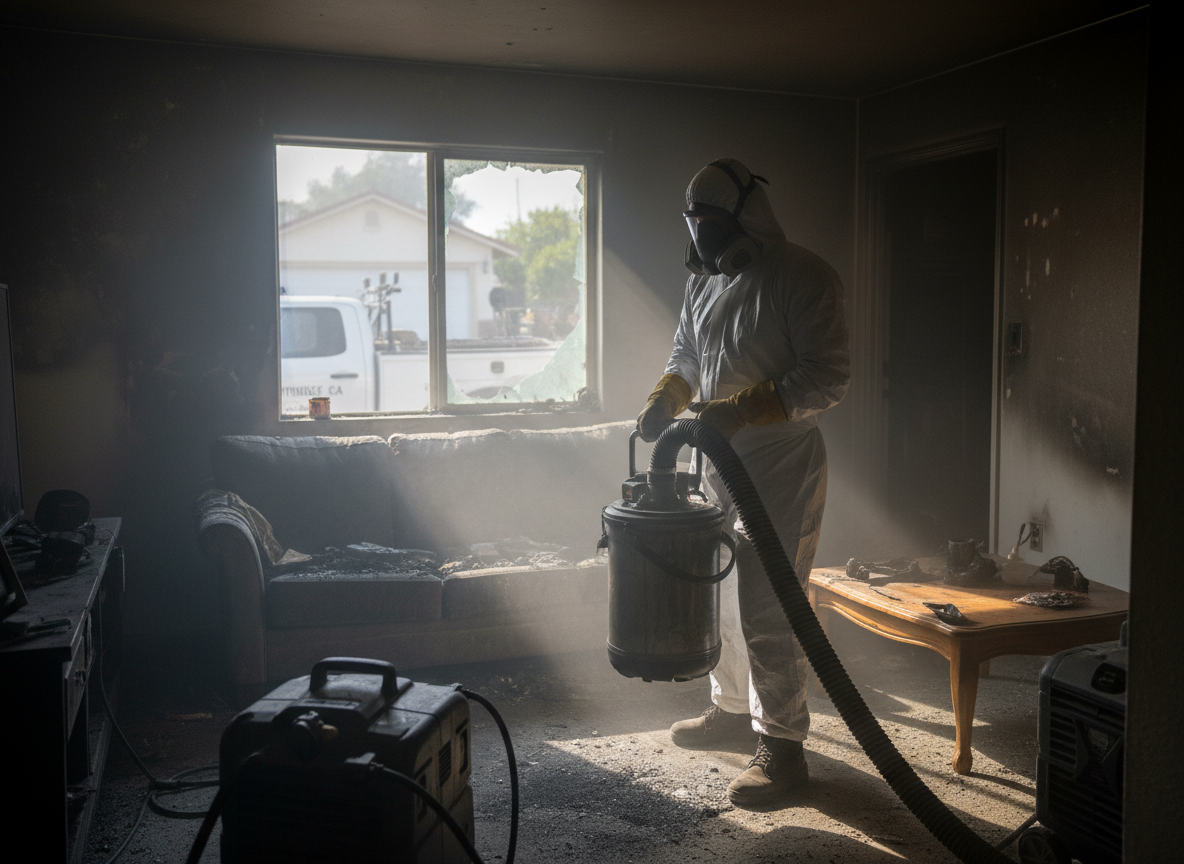
Smoke from structure fires in Northridge travels quickly through the open floor plans common in 1950s and 1960s ranch homes found in Northridge West and along Reseda Boulevard. Hot summer temperatures in Los Angeles County’s Mediterranean climate keep particulates airborne longer, allowing them to settle into HVAC systems and behind drywall. Technicians must map airflow paths from the fire origin to distant rooms before any cleaning begins, or odors will return once the house is closed up again.
Porous materials such as popcorn ceilings, acoustic tiles, and the stucco exteriors typical around California State University Northridge absorb smoke oils that standard cleaning cannot reach. In Northridge East neighborhoods near the Northridge Fashion Center, crews often discover that attic insulation and ductwork have become reservoirs for soot, requiring removal rather than surface treatment. Failure to address these hidden deposits leaves a persistent smell that intensifies during the next heat wave.
Electrical wiring in older Northridge homes can carry smoke residue along its length, creating new odor sources weeks after the initial event. Remediation therefore includes isolating circuits and cleaning or replacing affected runs before walls are closed. Work in Granada Hills and Porter Ranch spill-over jobs follows the same protocol because the same housing stock and summer wind patterns exist across the San Fernando Valley.
Technician insight
In Northridge, the thing that catches most people out with Smoke remediation is how summer heat pulls smoke deep into the fiberglass batts inside exterior walls of 1960s homes near Reseda Boulevard; once those walls heat up again the odor returns no matter how clean the surfaces look.
Smoke in a Northridge West Ranch Home
A kitchen fire sent smoke through open ceiling joists into the attic of a 1964 home near the CSUN Campus Area. Inspection showed soot coating insulation and HVAC ducts that had carried particles into every bedroom. Crews removed the contaminated insulation, cleaned the ducts, and ran odor-neutralizing equipment for three days until no trace remained.
How it works
- 1
Initial Assessment
Technicians inspect every room, attic, and HVAC run to chart smoke migration patterns through the specific home layout.
- 2
Source Removal
Contaminated insulation, carpet padding, and duct sections that cannot be cleaned are removed and disposed of according to Los Angeles County guidelines.
- 3
Surface Cleaning
Non-porous surfaces receive degreasing agents formulated for smoke oils; porous surfaces receive targeted sealing treatments.
- 4
Odor Neutralization
HEPA air scrubbers and hydroxyl generators run until no detectable smoke odor remains, with final clearance testing performed in living spaces.
Pricing
Pricing varies with the volume of affected space, depth of smoke penetration into cavities, and whether HVAC or insulation replacement is needed.