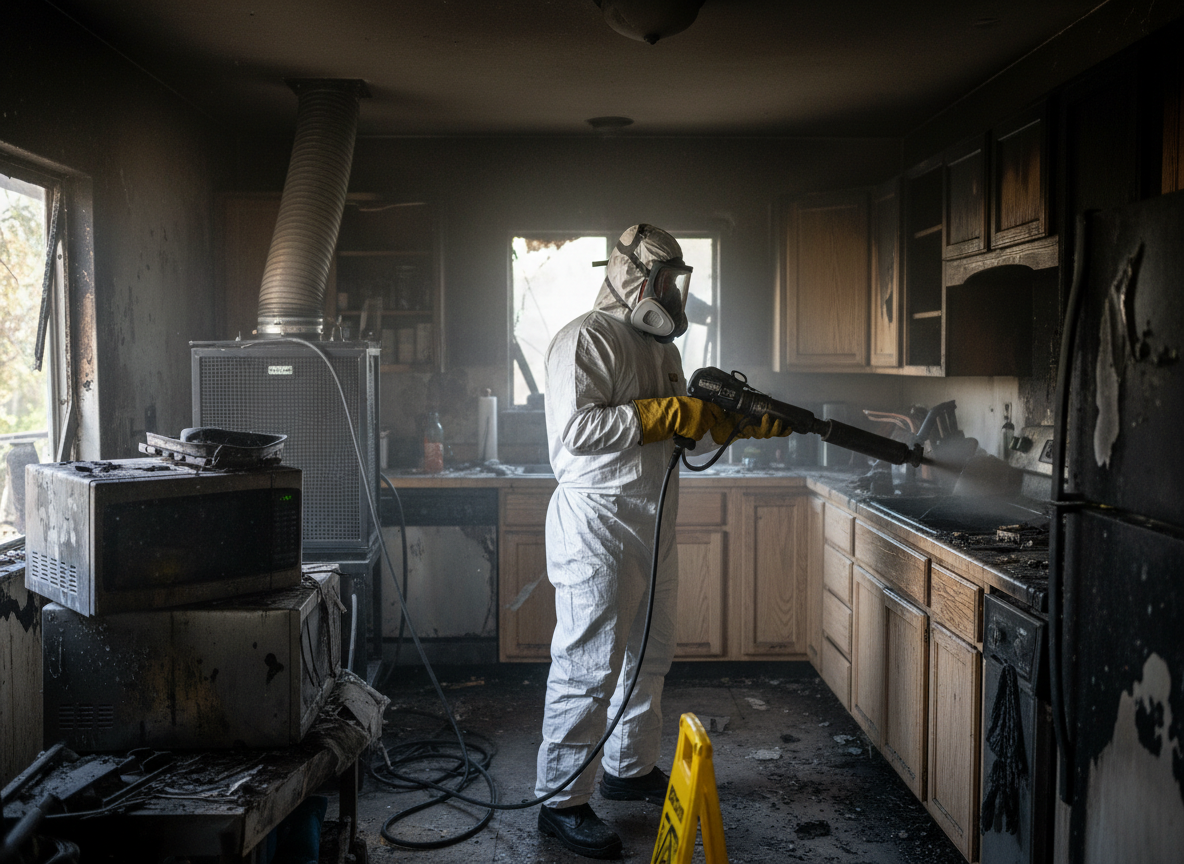
Smoke from structure fires in Northridge travels quickly through the single-story ranch homes and mid-century apartments common in Northridge East and Northridge West. Soot particles settle into textured ceilings, HVAC ducts, and the porous stucco exteriors that dominate the area near Reseda Boulevard. Hot summer temperatures in the Mediterranean climate keep these particles airborne longer, allowing them to penetrate deeper into insulation and cabinetry before crews arrive.
Restoration crews must address both visible char and invisible acidic residues that continue to corrode metal and discolor paint weeks after the fire is out. In neighborhoods bordering California State University Northridge, older forced-air systems often spread smoke through entire blocks of homes when filters are not sealed immediately. Odor neutralization requires thermal fogging and hydroxyl generators rather than simple ozone treatments because the latter can damage electronics still common in student housing around the campus.
Work in Los Angeles County also means coordinating with local inspectors on properties near the Northridge Fashion Center where commercial buildings share walls with residences. Technicians test pH levels on drywall and wood framing before sealing, because residual acids left behind cause recurring staining once humidity rises in late summer. Contents cleaning follows the same protocol, with ultrasonic methods used on items from nearby Porter Ranch and Granada Hills homes that cannot be wiped without embedding soot further into fabric.
Technician insight
In Northridge the thing that catches most people out with smoke damage restoration is how the hot summers push soot deeper into the older drywall and stucco found around California State University Northridge and Northridge East, so sealing too soon without pH testing just locks the acid in.
Smoke Migration Through Shared Walls
A fire in an attached garage on a Northridge West street sent smoke through a common wall into living spaces. Crews found acidic residue had traveled through the HVAC and settled in bedrooms near Reseda Boulevard. They isolated the system, removed soot from ducts and drywall, then neutralized odors before handing the home back for occupancy.
How it works
- 1
Initial Assessment
Technicians inspect every room, test surfaces for pH, and map smoke migration paths through ducts and wall cavities.
- 2
Containment and Ventilation
Negative air machines isolate affected zones while fresh air exchanges prevent cross-contamination to unaffected areas.
- 3
Soot Removal
Specialized sponges and HEPA vacuums remove loose particles from walls, ceilings, and contents without spreading residue.
- 4
Odor Neutralization
Thermal fogging and air scrubbers treat embedded odors in porous materials after visible cleaning is complete.
- 5
Final Clearance
Independent testing confirms surfaces are neutral and odors are gone before reconstruction or reoccupancy.
Pricing
Cost depends on square footage affected, depth of smoke penetration into HVAC systems, and whether contents require off-site processing.